
Home » Shockwave Therapy for Patellar Tendinopathy
Patellar Tendinopathy (Jumper's Knee) Treatment with Shockwave Therapy
Sharp, localised pain right at the front of the knee that flares up with jumping, squatting, or landing is the hallmark of patellar tendinopathy — and it's a stubborn one, especially for anyone who plays a jumping or sprinting sport. When rest and standard rehab haven't shifted it, shockwave therapy offers an evidence-supported way to restart the tendon's stalled healing process.

What Is Patellar Tendinopathy?
Patellar tendinopathy — widely known as jumper's knee — is a degenerative condition of the tendon connecting your kneecap (patella) to your shinbone, almost always presenting as sharp, well-localised pain right at the lower pole of the patella. It's most common in sports involving repeated jumping and landing — basketball, volleyball, and track and field are the classic culprits — because every jump loads the tendon eccentrically as it absorbs and redirects force on landing. Like other tendinopathies, what's happening at a tissue level isn't inflammation in the traditional sense; it's a genuine breakdown of the tendon's collagen structure that standard rest alone often fails to reverse.
Proximal Patellar Tendinopathy
By far the most common presentation. Pain and thickening occur at the inferior pole of the patella, where the tendon takes on the greatest tensile and compressive load during deceleration and jump-landing. This is the classic "jumper's knee" site, and the one most reliably treated with shockwave therapy.
Distal Patellar Tendinopathy
Less common — pain occurs lower down, where the tendon attaches to the tibial tuberosity. Can still respond to shockwave, though it's worth distinguishing from Osgood-Schlatter's changes at the same site in younger, still-growing athletes.
How Shockwave Therapy Helps
Shockwave therapy's proposed mechanism directly targets what's driving patellar tendinopathy: the acoustic pulses are thought to stimulate the formation of new blood vessels around the tendon, and to encourage more organised, structurally sound collagen as the tissue remodels. This tendon is particularly amenable to this kind of intervention because the inferior pole of the patella is a relatively poorly vascularised "watershed" zone, much like the Achilles mid-portion — which is part of why it's so slow to self-resolve without a stimulus to restart the repair process.
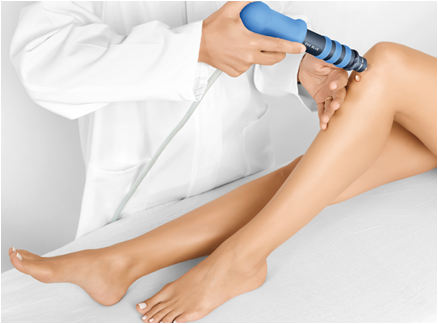
Delivered directly over the inferior pole of the patella using our BTL-6000 SWT radial shockwave device, focused on the precise site of degenerated tendon tissue.
Stimulates new blood vessel formation in a tendon origin that's naturally poorly vascularised, improving the supply of nutrients needed for repair.
Encourages the tendon to lay down more organised collagen fibres, replacing the disorganised structure typical of chronic tendinopathy.
Combined with a structured quadriceps-loading programme — typically isometric loading early on, progressing to heavy-slow-resistance and eventually jump-specific work — to teach the remodelling tendon to handle real deceleration and landing forces again.
Most patients complete 3 to 5 sessions, roughly a week apart. We'd generally suggest avoiding jumping, sprinting, or other high-impact loading for about 48 hours after each session. Your return-to-sport timeline is guided by how your tendon is tolerating load — particularly single-leg decline squats and jump-landing drills — not a fixed calendar date, since going back to full training too soon on a still-vulnerable tendon is one of the more common ways this injury becomes a recurring, season-long problem.
Is It Right for Your Knee Pain?
Shockwave therapy tends to be worth considering for anterior knee pain centred at the patellar tendon that's lasted more than 6 weeks and hasn't responded to rest and a genuine period of structured quadriceps loading. It's generally used for degenerative tendinopathy rather than an acute tendon tear or a different source of anterior knee pain, so a thorough assessment is an important first step to confirm the tendon itself — rather than the kneecap joint or surrounding structures — is what's driving your symptoms. Book an appointment and we'll confirm whether it's the right fit for you.
Jumper's Knee Not Settling Down?
Book an assessment to find out whether shockwave therapy and a structured loading plan are the right next step.
Meet Our Shockwave Therapy Specialist

At Benchmark Physio, our Shockwave Therapy sessions are performed by Ng Hong Kai. Hong Kai shares an unwavering passion for the field and has over 12 years of experience with musculoskeletal physiotherapy.
As the Clinic Director and Chief Physiotherapist, Hong Kai’s commitment to quality care is also evident through his extensive credentials. Under Hong Kai’s guidance, you can be assured of receiving treatments rooted in expertise, experience, and genuine passion for your wellbeing.
Ready to embark on a journey towards better musculoskeletal health free from pain? Schedule your consultation with us today.