
Home » Elbow and Wrist Fracture Fixation Physiotherapy in Singapore
Part of our post-surgery physiotherapy service
Elbow and Wrist Fracture Fixation Physiotherapy in Singapore
After a broken wrist or elbow is fixed with a plate, screws or wires, the bone heals in weeks but stiffness can last for months. Rehabilitation is about moving the fingers, wrist and elbow early within your surgeon's limits, protecting the fixation from heavy loads, and then rebuilding grip and arm strength for work, driving and sport. Benchmark Physio guides each stage, from the first weeks in a splint or sling to lifting and racket sport, at our Bukit Timah clinic and at home across Singapore.
- APA Titled expertise
- One-to-one sessions
- Clinic in Bukit Timah, home visits across Singapore
- Direct billing with selected insurers
Reviewed by Ng Hong Kai, Chief Physiotherapist. Last reviewed November 2026.
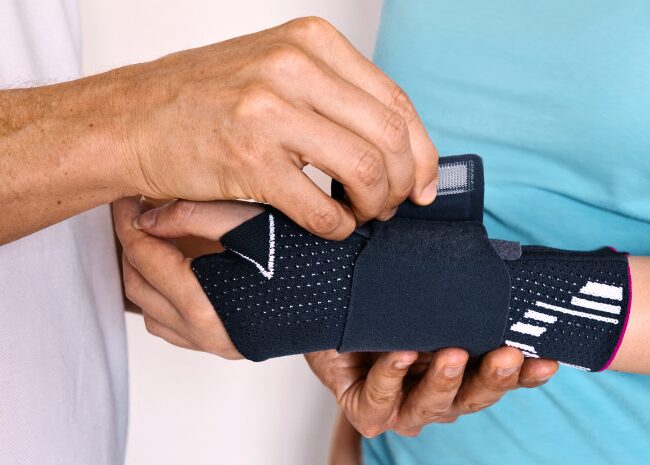
Elbow and wrist fracture surgery rehabilitation at a glance
- Operations covered
- Wrist (distal radius) plate or wire fixation, radial head fixation or replacement, and olecranon fixation.
- Wrist movement
- Can start straight after a stable volar plate or after about 2 weeks in a splint. A trial found no difference between the two.
- Elbow movement
- Gentle bending, straightening and forearm turning from the first days in NHS leaflets. A sling for up to about 2 weeks.
- Lifting
- Light use only for about 6 weeks. Heavy lifting, hard gripping and pushing up through the hand from about 3 months.
- Driving
- From about 6 to 8 weeks for most people, and never in a sling or splint.
- Clinic
- Benchmark Physio, 557 Bukit Timah Road, #02-03, Crown Centre, Singapore 269694
- Fees
- A clinic session costs $210 for 45 minutes, and a home visit $320. More services are on the fees page.
- Booking
- Book online or WhatsApp +65 8836 8526.
What makes elbow and wrist fracture rehabilitation different?
Elbow and wrist fracture fixation holds the broken bone with a plate, screws or wires, so the joint can move long before the bone has fully healed. Rehabilitation is a race against stiffness: the fingers, wrist and elbow stiffen quickly when they are kept still, and the elbow in particular is slow to give back movement once it is lost.
Bone takes about six weeks to heal and roughly another six weeks to become nearly as strong as before, according to Imperial College Healthcare NHS Trust. In that time the plan protects the fixation from heavy loads while keeping the fingers, wrist, elbow and shoulder moving. Singapore General Hospital asks people to keep the operated hand above heart level and to move the fingers often to prevent stiffness (SGH patient leaflet).
Our post-surgery physiotherapy page sets out the general stages of recovery, your first appointment and the warning signs after any operation. This page covers the fixed elbow and wrist. If your fracture was treated in a cast without surgery, or you have a sprain, see our wrist strain and sprain page or elbow pain page instead.
Which operation did you have, and how does it change rehabilitation?
The three common operations are a plate or wires for a broken wrist (distal radius), fixation or replacement of the radial head at the elbow, and wires or a plate for the olecranon, the point of the elbow. Each one has its own early limits and its own lingering problem.
| Operation | What the surgeon does | Support afterwards | Early movement | What tends to linger |
|---|---|---|---|---|
| Distal radius plate (wrist ORIF) | A plate and screws, usually on the palm side of the wrist, hold the end of the radius. | A dressing or splint for about 10 to 14 days in one NHS pathway (Swansea Bay), then a soft support if needed. | Fingers from day one. Wrist movement immediately or after about 2 weeks, as your surgeon prefers. | Finger and wrist stiffness, grip strength and forearm turning. |
| Distal radius wires (K-wires) | Thin wires through the skin hold the fragments. | A plaster for up to 6 weeks, with wires removed in clinic after 4 to 6 weeks (UHCW NHS). | Fingers, elbow and shoulder while in plaster. The wrist starts once the plaster is off. | Wrist stiffness after the longer time in plaster. |
| Radial head fixation or replacement | Screws or a small plate fix the top of the radius at the elbow, or a metal implant replaces it. | A sling for up to 2 weeks in one NHS leaflet (Royal Berkshire). | Wrist, hand and gentle elbow movement in the first two weeks, without pushing into a stretch. | Loss of full straightening and of forearm turning (palm up and down). |
| Olecranon fixation | Wires and a tension band, or a plate, fix the point of the elbow. | A sling for comfort only, reduced as you are able (WWL NHS). | Gentle movement from the day of surgery. Nothing heavier than a cup of tea, and no pushing through the hand, for 6 weeks. | Loss of straightening, and metalwork that rubs under the skin. |
Other fractures, such as the lower end of the upper arm bone (distal humerus), the scaphoid or the fingers, follow their own rules. Bring your operation note and we will work from it.
Moving the wrist early after a plate: what does the evidence show?
After a stable volar plate, starting wrist movement straight away and waiting about two weeks in a splint appear to give similar results. The timing matters less than many people fear, and your surgeon decides which approach suits your fracture.
A randomised trial of 48 people published in Scientific Reports in 2022 let one group move the wrist immediately after volar plate fixation and kept the other in a splint for two weeks. Function, pain, grip and wrist movement improved in both groups with no significant difference at any point, and X-ray results and complications did not differ.
The wider evidence is thin. A Cochrane review of 26 trials with 1,269 people (2015) found not enough evidence to say which form of rehabilitation works better than another after a broken wrist. After plate fixation, low-quality evidence favoured a structured home exercise programme with instruction over routine therapy sessions, and accelerated rehabilitation gave a short-term benefit that did not last.
Guidelines say much the same. The American Academy of Orthopaedic Surgeons advised in 2009 that early wrist motion is not routinely needed after stable fixation, and its 2020 guideline found the evidence comparing home exercise with supervised therapy inconsistent.
What this means in practice
- Most people do well with a clear home programme and a few well-timed sessions to check and progress it.
- More supervised help makes sense when the fingers will not make a full fist, the wrist is not loosening, grip is lagging or your job needs a strong hand.
- In Singapore's public hospitals, wrist rehabilitation after surgery is often led by hand occupational therapists (SGH, NUH). If you are already seeing one, we can work alongside that plan rather than duplicate it.
Elbow and wrist fracture surgery recovery: what to expect by week
A common pattern is light use of the hand for about six weeks, driving from about six to eight weeks, heavy lifting and hard gripping from about three months, and a hand or elbow that feels close to normal by four to six months. The table combines Singapore and NHS advice, which differs between hospitals.
| Time since surgery | Wrist (distal radius plate) | Elbow (radial head or olecranon) | Everyday life |
|---|---|---|---|
| 0 to 2 weeks | Hand raised above heart level. Fingers, thumb, elbow and shoulder moved often. Aim for a full fist by 2 weeks (Imperial). | Sling for up to about 2 weeks. Gentle bending, straightening and forearm turning, without pushing into a stretch (Royal Berkshire, WWL). | One-handed tasks. Dressing or splint for about 10 to 14 days. First review at about 2 weeks. |
| 2 to 6 weeks | Light tasks only, lifting no more than 1 kg. Scar massage once the wound has healed (Swansea Bay). | Formal physiotherapy from about 2 weeks. After olecranon fixation, nothing heavier than a cup of tea and no pushing up through the hand. | Desk work as you are able, without lifting. No driving in a sling or splint. |
| 6 to 12 weeks | Supports weaned off and the hand used more. Strength work builds once your surgeon allows it. | Movement and early strength. Breaststroke from about 8 weeks in one leaflet. | Driving from about 6 to 8 weeks (Southampton, Swansea Bay, Royal Berkshire). |
| 3 to 6 months | Heavy lifting, hard gripping and weight through the hand from about 3 months. Feeling reasonably normal by 4 to 6 months (UHCW). | Heavy lifting from 3 months or more. Golf from 12 weeks, freestyle swimming from 3 months, contact and racket sports from 3 to 6 months. | Heavier and manual work from about 3 months, on your surgeon's advice. |
| 6 to 18 months | After complex injuries, 6 to 12 months to use the hand as normal (Imperial). Improvement can continue for up to 18 months. | Stiffness and weakness can take several months to settle (RUH Bath). | Hardware removal is discussed only if it bothers you. |
Sources include Singapore General Hospital, Imperial College Healthcare, Swansea Bay, University Hospital Southampton, University Hospitals Coventry and Warwickshire, Royal Berkshire, Wrightington, Wigan and Leigh and Royal United Hospitals Bath. Your surgeon's instructions take priority over any timing here.
Why are the fingers, wrist and elbow stiff and weak, and for how long?
Stiffness is the main problem after elbow and wrist fracture surgery, and it eases over months. At the wrist it shows in a weak grip and a tight fist; at the elbow it usually shows as an arm that will not fully straighten.
About 5% of people lose elbow movement after an injury, and loss of straightening is commoner than loss of bending, according to a StatPearls review of the stiff elbow. Most everyday tasks need the elbow to move between about 30 and 130 degrees, so a few degrees short of straight is often livable, while a larger loss affects reaching and carrying. The same review notes that extra bone can form around the joint (heterotopic ossification) in up to 20% of elbow fractures and complex dislocations.
At the wrist, a UHCW NHS leaflet says the joint may stay tender for two to three months and that feeling reasonably normal can take four to six months, with improvement for up to 18 months. Grip strength is often the last thing to come back.
What helps
- Keep the hand raised in the first two weeks, and move the fingers little and often.
- Practise the movements you were shown several times a day. Short, frequent sessions beat one long one.
- At the elbow, work on straightening and on turning the palm up as well as bending. These are the movements most likely to be lost.
- Use the hand for light daily tasks as soon as you are allowed, such as eating with chopsticks, typing and holding your phone. Leave carrying shopping bags and heavy pots until your surgeon clears it.
- Massage the scar once it has healed, as Swansea Bay advises, to keep the skin and tendons gliding.
Driving, work and sport after elbow or wrist fracture surgery
Most people can drive from about six to eight weeks, return to desk work within the first few weeks if they avoid lifting, and go back to heavy work and contact or racket sports from about three to six months.
For the wrist, a University Hospital Southampton leaflet says not to drive until at least six to eight weeks after surgery, and Swansea Bay says driving can be considered from six weeks if you feel safe and confident. For the elbow, Royal Berkshire gives six weeks as the earliest. Do not drive in a sling (RUH Bath). You need to hold the steering wheel firmly and turn it quickly, so check with your insurer as well.
Desk work can resume early with no lifting. Heavier duties wait for about three months in the Royal Berkshire elbow leaflet, and Swansea Bay advises avoiding heavy lifting, hard gripping and weight through the hand for three months after wrist surgery. That includes push-ups, yoga poses on the hands and pushing up from a chair.
For sport, Royal Berkshire allows breaststroke from eight weeks, freestyle and golf from about three months (but not the driving range) and contact and racket sports from three to six months. Badminton and tennis put repeated load through the wrist and forearm, so we use grip strength, movement and loading tests to decide, not the date alone.
Complications and hardware: what to watch for
Most elbows and wrists heal without trouble, but a few problems need prompt attention. The ones to know about are wound infection, nerve symptoms, pain out of proportion to the injury and metalwork that irritates.
- Fever of 38°C or higher, a red, smelly or leaking wound, severe pain not eased by your medicine, or a hand that turns cold, blue or numb: Singapore General Hospital advises going to its Emergency Department (SGH leaflet). Contact your own surgeon's team or emergency department straight away.
- Pins and needles or colour change in the fingers when the arm is bandaged: loosen any compression sleeve and speak to your therapist, as WWL NHS advises.
- Pain, swelling, colour or temperature changes that seem far out of proportion: tell your surgeon. Complex regional pain syndrome is uncommon, recorded in 0.31% of people within a year of wrist fracture surgery in a Danish register study of over 200,000 people (2026).
- A plate that rubs or irritates a tendon at the wrist: removal is not routine. In one US hospital, 33 volar plates were removed out of about 1,100 fitted over six years, most often for pain or tendon irritation.
- Wires at the point of the elbow often bother people when leaning on the arm. In a Danish study of 55 people (2000) with tension band wiring of the olecranon, 72% had a second operation, mostly to remove wires that were causing symptoms. Newer plates may differ.
- Calf pain, chest pain or breathlessness: see the warning signs on our post-surgery page.
How we run elbow and wrist fracture rehabilitation at Benchmark Physio
We start from your operation note, follow your surgeon's rules on splints and lifting, and rebuild movement, grip and arm strength step by step.
We start from your operation note
Your note tells us which bone was fixed, how and your surgeon's rules on splints, slings and lifting. We agree which steps come when.
We protect the fixation and keep the rest moving
While the bone heals, we keep the fingers, thumb, elbow and shoulder moving, settle swelling and show you how to manage one-handed.
We measure movement and grip
We measure elbow straightening, forearm turning, wrist movement and grip strength against the other side, so progress and plateaus are clear.
Home visits suit the first weeks
A home visit ($320 for 45 minutes) helps when you cannot drive. Clinic sessions ($210) and online check-ins ($100 for 30 minutes) fit around it. Open the fees and insurance section of the post-surgery page to see which insurers we bill directly.
Our lead physiotherapist holds APA Titled status and trained as an Exercise Scientist, so graded loading, from the first light grip to lifting and racket sport, is part of our everyday work.
Frequently asked questions about elbow and wrist fracture surgery rehabilitation
How long does it take to recover from wrist fracture surgery?
When can I start moving my wrist after a plate?
Is a home exercise programme enough after wrist fracture surgery?
Why will my elbow not straighten fully after surgery?
When can I drive after elbow or wrist fracture surgery?
When can I lift things and go back to work after elbow or wrist fracture surgery?
Will the plate or wires need to come out?
How long does grip strength take to come back after a wrist fracture?
Book your elbow or wrist fracture rehabilitation assessment
Tell us your surgery date, which bone was fixed and the splint and lifting rules you were given. We will tell you where you are in the recovery and what comes next.
Benchmark Physio, 557 Bukit Timah Road, #02-03, Crown Centre, Singapore 269694
Call or WhatsApp +65 8836 8526. Email info@benchmarkphysio.com. Get directions.
Tuesday and Thursday 11am to 8pm. Wednesday, Friday and Saturday 9am to 6pm. Closed on Monday and Sunday.
Related services
Sources
The ranges and figures on this page come from the hospital guidance, studies and guidelines below. Protocols differ between surgeons and hospitals, so your own instructions take priority. Last reviewed November 2026.
- Distal radius fracture surgery: patient information. Singapore General Hospital, Department of Hand and Reconstructive Microsurgery
- Hand and wrist fractures. National University Hospital, Singapore
- Fractured wrist: after surgery. Imperial College Healthcare NHS Trust, Hand Therapy, 2018
- Open reduction internal fixation (ORIF) of the wrist. Swansea Bay University Health Board
- Wrist fracture advice after an open reduction and internal fixation (ORIF). University Hospital Southampton NHS Foundation Trust, 2023
- Fractured wrist needing surgery. University Hospitals Coventry and Warwickshire NHS Trust, 2025
- Radial head ORIF: advice and exercises. Royal Berkshire NHS Foundation Trust, 2026
- Olecranon fracture fixation surgery: advice and exercises. Wrightington, Wigan and Leigh Teaching Hospitals NHS Foundation Trust
- Advice after breaking your radial head or neck (elbow). Royal United Hospitals Bath NHS Foundation Trust, 2025
- Laohaprasitiporn P and others. Comparative clinical and radiographic outcomes between early and delayed wrist mobilization after volar fixed-angle plate fixation of distal radius fracture. Scientific Reports, 2022
- Handoll HHG, Elliott J. Rehabilitation for distal radial fractures in adults. Cochrane Database of Systematic Reviews, 2015
- The treatment of distal radius fractures: guideline and evidence report. American Academy of Orthopaedic Surgeons, 2009
- Management of distal radius fractures: clinical practice guideline. American Academy of Orthopaedic Surgeons, 2020
- Stiff elbow. StatPearls
- Melbye P and others. Incidence proportion of complex regional pain syndrome (CRPS) after distal radius fracture: a population-based register study. Acta Orthopaedica, 2026
- Snoddy MC and others. Incidence and reasons for hardware removal following operative fixation of distal radius fractures. Journal of Hand Surgery, 2015
- Romero JM, Miran A, Jensen CH. Complications and re-operation rate after tension-band wiring of olecranon fractures. Journal of Orthopaedic Science, 2000
Meet Our Physiotherapist

Ng Hong Kai also provides dedicated post-surgery rehab programs. With his in-depth understanding of anatomy and surgical procedures, he helps clients recover safely and effectively after operations like joint replacements, ACL reconstruction, and rotator cuff repair. His hands-on physiotherapy approach addresses range of motion, strength, and function to facilitate healing and achieve optimal outcomes.
Ready to embark on a journey towards better musculoskeletal health free from pain? Schedule your consultation with us today.