
Home » Shockwave Therapy for Golfer’s Elbow
Physiotherapy-Led Shockwave Treatment
Shockwave Therapy for Golfer's Elbow in Singapore
Inner elbow pain that hasn't settled with rest, bracing, or standard exercises? Radial shockwave therapy targets the degenerative tendon changes behind chronic golfer's elbow — restarting a healing response that's stalled rather than actively repairing.

1. What Is Golfer's Elbow?
Golfer's elbow — medically known as medial epicondylalgia or medial epicondylitis — is pain and tenderness on the bony bump on the inside of your elbow, where the tendons of your wrist flexor and forearm pronator muscles attach. Despite the name, it's just as common in people who've never swung a golf club; it's frequently seen in throwing-sport athletes, weightlifters, tradespeople using power tools, and anyone whose work or hobbies involve repetitive gripping combined with wrist flexion or forearm rotation.
Like its lateral counterpart, chronic golfer's elbow is not primarily driven by active inflammation. Tissue examined in longstanding cases typically shows tendinosis — disorganised collagen fibres, increased ground substance, and abnormal blood vessel ingrowth — rather than the inflammatory cell picture you'd expect in acute tendinitis. This matters for treatment: it's one of the main reasons shockwave therapy is considered for cases that haven't responded to rest and anti-inflammatory measures alone, since it targets a stalled, degenerative healing process rather than active inflammation.
Where the pain comes from
The common flexor tendon — the shared origin point for the wrist flexor and forearm pronator muscles — attaches at the medial epicondyle. Repetitive tensile loading during gripping, throwing, and forearm rotation places this specific site under sustained mechanical stress, and it's here that the earliest degenerative changes are typically found.
2. How Shockwave Therapy Helps Golfer's Elbow
Shockwave therapy uses targeted acoustic pulses to convert mechanical energy into a biological signal — a process called mechanotransduction — prompting degenerative tendon tissue to re-engage a genuine healing response. For golfer's elbow specifically, this works through several mechanisms at the common flexor tendon origin:
Improved Blood Flow to the Flexor Origin
The medial epicondyle region can become relatively poorly vascularised in chronic cases, limiting the tendon's own capacity to repair. Acoustic pulses stimulate neovascularisation — new capillary formation — improving nutrient supply to this stalled tissue.
Collagen Remodelling
Mechanical pressure activates fibroblasts, encouraging the tendon to lay down a more organised, resilient collagen matrix in place of the disorganised tissue characteristic of chronic tendinosis.
Pain Signal Disruption
Shockwave can deplete Substance P — a neurotransmitter tied to pain signalling — and overstimulate local nerve fibres, reducing the transmission of chronic pain signals from the elbow to the brain via the gate control mechanism.
Breaking Down Adhesions
Where dense, disorganised scar tissue has built up at the flexor origin restricting normal glide, the mechanical pulses help fragment this tissue, supporting improved local mobility.
At Benchmark Physio, we use a BTL-6000 SWT radial shockwave device — the right choice for golfer's elbow, since the common flexor origin is a superficial-to-moderate depth structure well suited to radial (rather than focused) shockwave delivery. One practical note specific to this condition: your physiotherapist positions the applicator carefully around the medial epicondyle, since the ulnar nerve runs close to this site. Read more about radial vs focused shockwave technology on our main shockwave therapy page.
3. Golfer's Elbow vs Tennis Elbow
Golfer's elbow and tennis elbow are often confused because they're both overuse tendon conditions at the elbow, but they affect opposite sides of the joint and different tendon groups entirely. Getting this distinction right matters for treatment, since shockwave is applied to a different, specific site depending on which one you have.
| Feature | Golfer's Elbow | Tennis Elbow |
|---|---|---|
| Medical name | Medial epicondylalgia | Lateral epicondylalgia |
| Pain location | Inner (medial) side of elbow | Outer (lateral) side of elbow |
| Tendon involved | Wrist flexors / pronator teres | Wrist extensors (mainly ECRB) |
| Aggravated by | Gripping, wrist flexion, forearm rotation | Gripping, lifting with palm down, wrist extension |
| Common causes | Golf swing, throwing sports, repetitive flexion tasks | Backhand technique, repetitive gripping, mouse/keyboard use |
Both conditions respond to the same underlying shockwave mechanism — the difference is entirely in where the applicator is positioned. If your pain is on the outer elbow rather than the inner elbow, see our dedicated page on shockwave therapy for tennis elbow. If you're not sure which you have, that's exactly what the initial assessment is for.
4. Is Shockwave Right for Your Golfer's Elbow?
Shockwave isn't the first thing we reach for with every case of medial elbow pain — it's generally considered once standard approaches haven't fully resolved things. Your physiotherapist will confirm suitability during assessment.
Tends to be a good fit if:
- Your medial elbow pain has persisted more than 6 weeks despite rest or activity modification
- You've tried a course of standard physiotherapy — exercise, manual therapy, bracing — without full resolution
- You've been told you have tendinosis or a "chronic" version of golfer's elbow
- You want to explore non-surgical options before considering a steroid injection or surgery
- Gripping, throwing, or swing-based activity still aggravates the pain despite rehab
Generally avoided if:
- You're pregnant
- You have a blood clotting disorder or are on blood-thinning medication
- There's active malignancy near the treatment site
- You have symptoms suggestive of ulnar nerve involvement (tingling into the ring and little fingers) that need assessment first
- Your pain is very recent-onset (under 6 weeks) and may still resolve with conservative care alone
5. What to Expect From a Session
Assessment First
Your physiotherapist confirms this is genuinely medial epicondylalgia — and specifically rules out ulnar nerve involvement, which can produce similar inner-elbow symptoms and needs a different approach — before treatment begins. Contraindications are checked and the precise site of tendon irritation is located by palpation.
The Treatment
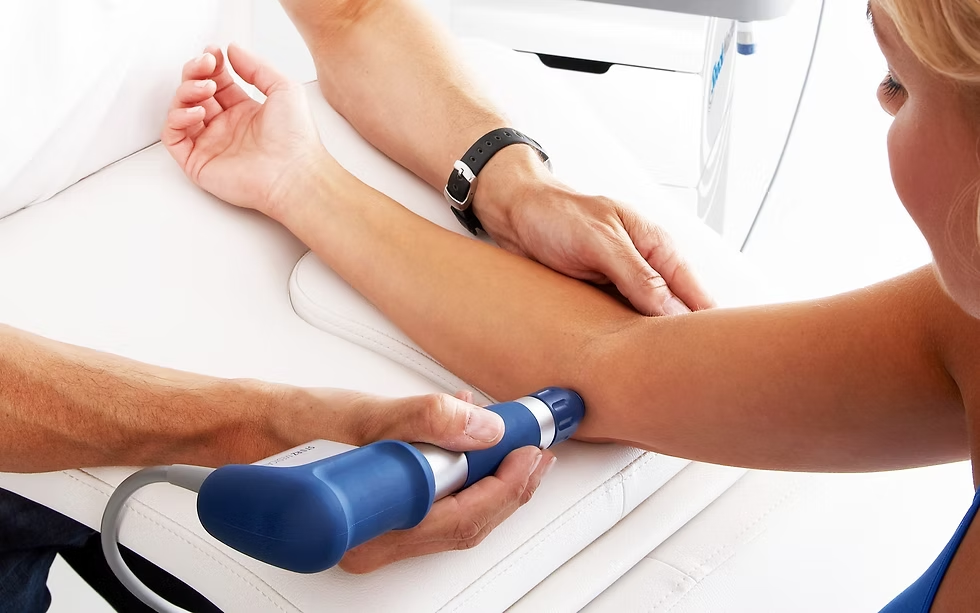
Conductive gel is applied over the medial epicondyle, and the BTL-6000 handheld applicator delivers a series of acoustic pulses — typically 2,000 to 3,000 per session — directly to the flexor tendon origin, with careful positioning around the nearby ulnar nerve. Most patients describe it as a firm, rhythmic tapping; your physiotherapist adjusts intensity continuously based on your feedback.
Immediately After
Normal daily activities can generally resume right away. We advise avoiding heavy gripping, throwing, or swing-based activity for 48 hours, since the tendon is in an active state of biological signalling and loading it too soon can interrupt that process.
Over the Course of Treatment
Most patients complete 3 to 5 sessions, generally spaced around a week apart. Some notice symptom easing after the first session or two, but the fuller structural remodelling of the tendon typically continues over 8–12 weeks.
Shockwave for golfer's elbow is delivered as part of a complete recovery plan — combined with a full assessment, manual therapy where appropriate, and a progressive loading programme targeting the wrist flexors and pronators. Treating the pain in isolation, without correcting the grip or swing mechanics that contributed to it, is one of the most common reasons golfer's elbow returns after initial improvement.
6. Fees
Physiotherapy Session
45 minutes — includes assessment, treatment, and shockwave if clinically indicated
$210
Shockwave Therapy
Add-on to a physiotherapy session
+ $80
Shockwave therapy is delivered as an add-on to a standard physiotherapy session rather than as a standalone appointment, so treatment is always paired with clinical assessment of your golfer's elbow. Coverage under private insurance or corporate health plans varies by provider — see our insurance partners for details, or check directly with your provider regarding "Extracorporeal Shock Wave Therapy" coverage. Full pricing for all services is on our fees page.
7. Frequently Asked Questions
Is shockwave therapy for golfer's elbow painful?+
Discomfort is generally mild to moderate — most patients describe a firm, rhythmic tapping sensation over the inner elbow rather than sharp pain. Because the ulnar nerve runs close to the medial epicondyle, your physiotherapist positions the applicator carefully and continuously adjusts intensity based on your feedback throughout the session.
How many sessions will I need for golfer's elbow?+
Most patients complete 3 to 5 sessions, typically spaced around a week apart. Some notice initial improvement after the first couple of sessions, while the fuller structural changes to the flexor tendon generally continue developing over 8–12 weeks. Your physiotherapist will discuss an expected course during your assessment and adjust it based on how you respond.
Can I keep playing golf or throwing sports during treatment?+
This depends on your specific presentation and will be discussed during your assessment. In general, we advise avoiding high-impact or strenuous gripping and throwing activity — including golf swings — for 48 hours after each shockwave session, since the tendon is in an active state of biological signalling during this window. Beyond that, your physiotherapist will guide a gradual return based on how your symptoms and loading tolerance are progressing.
How is golfer's elbow different from tennis elbow?+
They affect opposite sides of the elbow and different tendon groups. Golfer's elbow involves the wrist flexor and pronator tendons on the inner (medial) elbow, while tennis elbow involves the wrist extensor tendons on the outer (lateral) elbow. The shockwave mechanism is the same for both — only the applicator placement differs. Your physiotherapist confirms which condition you have during assessment.
Will shockwave therapy fix my golfer's elbow on its own?+
Shockwave is best understood as a catalyst rather than a standalone fix. It can restart the biological healing process in a stalled flexor tendon, but the newly forming tissue still needs to be progressively loaded and conditioned to tolerate gripping and swinging again. At Benchmark Physio, shockwave sessions are always combined with a loading and exercise programme targeting the wrist flexors and pronators — addressing pain without the loading component is a common reason golfer's elbow returns.
Are there side effects to shockwave therapy for golfer's elbow?+
Shockwave therapy is generally safe when administered by a trained physiotherapist. Mild, temporary side effects such as localised redness, swelling, or soreness at the inner elbow can occur and typically settle within 24–48 hours. These are a normal part of the body's response to treatment rather than a cause for concern.
Is shockwave therapy covered by insurance in Singapore?+
Coverage varies by policy and provider. Some private health plans and corporate insurance schemes cover shockwave therapy when clinically indicated, though this sometimes requires a specialist referral. We'd recommend checking with your provider directly, referencing "Extracorporeal Shock Wave Therapy" (ESWT) specifically. See our current insurance partners for more information.
Do I need a doctor's referral for shockwave therapy?+
No formal referral is required to book a physiotherapy assessment at Benchmark Physio, where your physiotherapist determines whether shockwave is appropriate for your golfer's elbow. If you're planning to claim through insurance, your specific policy may require a referral from a doctor or specialist — it's worth checking this with your provider ahead of your visit.
Go Deeper
More on golfer's elbow, elbow pain generally, and how shockwave fits within the wider Benchmark Physio approach.
Ready to Address Your Golfer's Elbow?
Book a physiotherapy assessment to find out whether shockwave therapy is a suitable option for your medial elbow pain.
Meet Our Shockwave Therapy Specialist

At Benchmark Physio, our Shockwave Therapy sessions are performed by Ng Hong Kai. Hong Kai shares an unwavering passion for the field and has over 12 years of experience with musculoskeletal physiotherapy.
As the Clinic Director and Chief Physiotherapist, Hong Kai’s commitment to quality care is also evident through his extensive credentials. Under Hong Kai’s guidance, you can be assured of receiving treatments rooted in expertise, experience, and genuine passion for your wellbeing.
Ready to embark on a journey towards better musculoskeletal health free from pain? Schedule your consultation with us today.