
Home » Ankle Fracture Fixation Physiotherapy in Singapore
Part of our post-surgery physiotherapy service
Ankle Fracture Fixation Physiotherapy in Singapore
After ankle fracture surgery, plates and screws hold the bones while they heal. Rehabilitation is about how soon to put weight through the ankle, how to win back movement and strength once the boot comes off, and how long swelling and stiffness will last. Benchmark Physio guides every stage, from the boot weeks to work and sport, at our Bukit Timah clinic and at home across Singapore.
- APA Titled expertise
- One-to-one sessions
- Clinic in Bukit Timah, home visits across Singapore
- Direct billing with selected insurers
Reviewed by Ng Hong Kai, Chief Physiotherapist. Last reviewed October 2026.
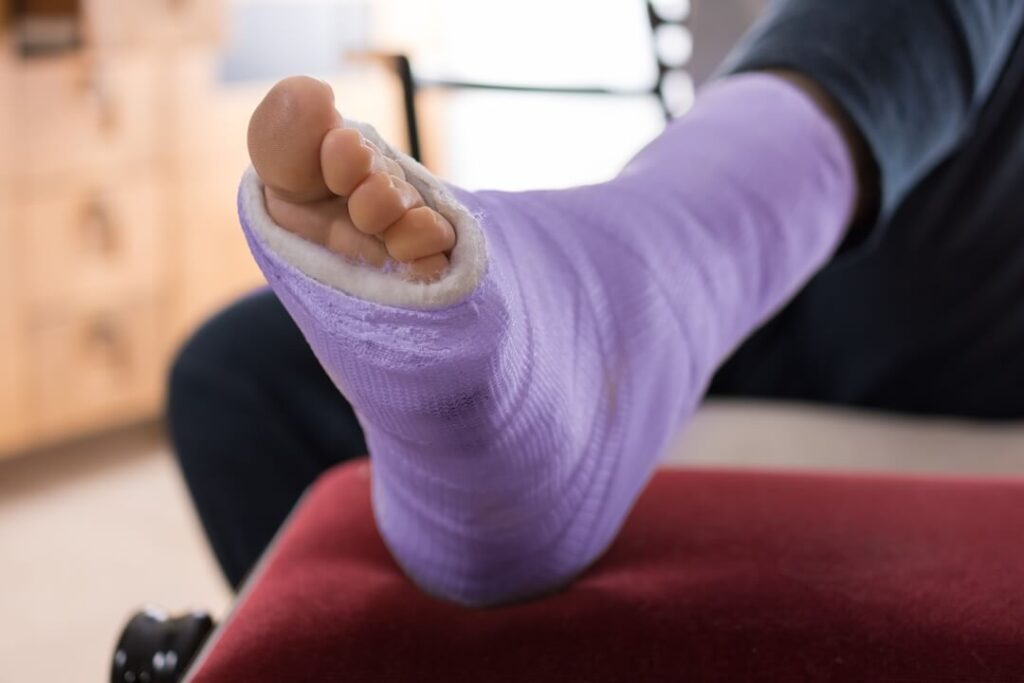
Ankle fracture surgery rehabilitation at a glance
- Boot
- About 6 weeks in one NHS leaflet, with full weight on crutches aimed for by 2 weeks.
- Weight-bearing
- From about 2 weeks in accelerated protocols to 4 to 6 weeks in others. Your surgeon decides.
- Early weight-bearing
- Safe in meta-analyses of randomised trials: better function at 12 weeks, no difference at a year.
- Swelling
- Often for several months, and after hard exercise for up to a year.
- Return to sport
- A standard time is about 12 weeks, and most activities return by 3 to 4 months.
- Clinic
- Benchmark Physio, 557 Bukit Timah Road, #02-03, Crown Centre, Singapore 269694
- Fees
- A clinic session costs $210 for 45 minutes, and a home visit $320. More services are on the fees page.
- Booking
- Book online or WhatsApp +65 8836 8526.
What makes ankle fracture rehabilitation different?
Ankle fracture fixation holds the broken bones in place with plates and screws, and rehabilitation is shaped by one question: how soon the ankle can take weight. Bone needs about six weeks to heal, but the joint stiffens, swells and weakens long before that, so the plan balances protection against the cost of keeping the ankle still.
Protocols vary a great deal. A UK research summary notes practice ranging from early functional rehabilitation with early weight-bearing to a cast or brace and no weight for six weeks (HRA summary). Surgery may also be postponed for a few days to let swelling settle, according to Ng Teng Fong General Hospital.
Our post-surgery physiotherapy page sets out the general stages of recovery and the warning signs. This page covers the fixed ankle.
Early or delayed weight-bearing: what does the evidence show?
Early weight-bearing helps in the first months and does not seem to cost anything later. A meta-analysis of 11 randomised trials with 930 patients found better ankle function at 12 weeks with early weight-bearing, no difference at one year, and no increase in complications.
A 2024 meta-analysis in the Journal of Foot and Ankle Research agreed, finding that early weight-bearing let people return to daily life sooner without more complications, and a 2021 meta-analysis found a gain in ankle function score at six weeks.
Two cautions apply. One review found that combining early weight-bearing with early movement raised the odds of wound complications (Bone and Joint Orthopaedic Proceedings, 2022), which may be why many protocols protect the wound for the first two weeks. And in an earlier meta-analysis, revision surgery was commoner after early weight-bearing, mostly for hardware removal, although the difference was not statistically significant.
Weight-bearing starts at different times: a Brighton NHS leaflet aims for full weight with crutches by two weeks, while a US protocol starts it at four to six weeks in most cases. Your surgeon sets the date.
Ankle fracture surgery recovery: what to expect by week
A common pattern is a boot for about six weeks, physiotherapy from around four to six weeks, a return to most activities at three to four months, and swelling that eases over several months. The table combines Singapore, NHS and US advice, which differs.
| Time since surgery | Boot and weight | Exercise | Everyday life |
|---|---|---|---|
| 0 to 2 weeks | Splint or boot. Little or no weight, unless your surgeon allows more. | Toe movement, and exercises for the hip and knee on the same leg as allowed. | Keep the foot raised to settle swelling. A first clinic visit at about 2 weeks. |
| 2 to 6 weeks | Boot worn all the time when walking. Full weight with crutches by about 2 weeks in some protocols, and from 4 to 6 weeks in others. | Ankle movement exercises within your surgeon's limits. Physiotherapy from about 4 weeks in one NHS leaflet. | Follow-up visits as your hospital arranges them. |
| 6 to 12 weeks | The boot comes off at about 6 weeks in one NHS leaflet. Walking in shoes, then without aids. | Movement, calf strength, balance and gentle walking practice. | Braking time returns to normal at about 9 weeks on average. Manual work waits for at least 6 weeks. |
| 3 to 6 months | Normal walking. | Strength, balance, hopping and running preparation. | Most activities back at 3 to 4 months. A standard return to sport is about 12 weeks. |
| 6 to 12 months | Walking and stairs feel normal. | Keeping strength and movement up. | Swelling can last for up to a year. Hardware removal is possible from about 6 months if it bothers you. |
Sources include Ng Teng Fong General Hospital, Brighton, Glasgow, Chelsea and Westminster and Twin Cities Orthopedics. Ng Teng Fong's brochure has follow-up visits at six weeks and three months.
Why is the ankle swollen, stiff and weak, and for how long?
Swelling, stiffness and calf weakness are the three lingering problems, and they ease over months, not weeks. A US protocol says swelling may persist for several months, and notes that the calf weakens during the weeks in a boot. An NHS leaflet says pain and swelling after strenuous activity can continue for up to a year.
Improvement can go on for longer than people expect: Chelsea and Westminster says pain, swelling and function may keep improving for over 12 months after surgery. A Glasgow NHS leaflet advises arranging physiotherapy if ankle stiffness is still affecting what you can do at 12 weeks.
What helps
- Raise the foot and use ice, especially after a busy day.
- Practise the movements you were shown, and add calf raises once you are allowed.
- Wear a supportive shoe once the boot is off, and walk as normally as you can.
- Squatting needs a good upward bend at the ankle, which is often the last movement to return, so ask us if floor sitting or squat toilets are part of your day.
Driving, work and sport after ankle fracture surgery
Driving waits until you are out of the boot and can make an emergency stop safely, and work and sport return from about six to twelve weeks. NHS leaflets advise against driving in the boot (North Tees and Hartlepool NHS), and braking time returned to normal at about nine weeks on average in studies quoted by one US protocol.
Most cars in Singapore are automatic, so it is the right ankle that matters for braking. A left-ankle fracture in an automatic is a question for your surgeon and your insurer.
For work, a Glasgow NHS leaflet says to expect at least six weeks off for lifting jobs, and manual work, sport and heavy activities from about week 12. A US protocol says most activities return at three to four months. Football and badminton load the ankle with cutting and landing, so we use strength, balance and hopping checks to decide, not the date alone.
Complications and hardware: what to watch for
Most ankles heal without trouble, but a few problems need prompt attention. The usual ones are infection, a wound that does not heal, stiffness and metalwork that irritates.
- A wound that is red, hot, leaking or opening, or feeling feverish with rising pain, swelling or stiffness (Glasgow NHS): contact your surgeon the same day.
- Stiffness that is still limiting you at 12 weeks: arrange physiotherapy.
- Metalwork that bothers you: your surgeon can discuss removal, which Ng Teng Fong General Hospital puts at about six months after surgery.
- Calf pain, swelling or warmth: see the warning signs on our post-surgery page.
How we run ankle fracture rehabilitation at Benchmark Physio
We start from your operation note, follow your surgeon's rules on weight and wound, and rebuild movement, calf strength and balance once the boot allows it.
We start from your operation note
Your note tells us which bones were fixed and your surgeon's rules on weight-bearing and the boot. We agree which steps come when.
We protect the wound and the bone first
While the boot is on, we keep the rest of the leg working and teach you to walk, climb stairs and travel safely on crutches.
We win back movement and calf strength
Once the boot is off, we measure ankle movement and single-leg calf raises against the other side, and build balance and hopping before sport.
Home visits suit the boot weeks
A home visit ($320 for 45 minutes) spares you the journey on crutches. Clinic sessions ($210) and online check-ins ($100 for 30 minutes) fit around it. Open the fees and insurance section of the post-surgery page to see which insurers we bill directly.
Our lead physiotherapist holds APA Titled status and trained as an Exercise Scientist, so graded loading from the first steps in the boot to jumping and landing is part of our everyday work.
Frequently asked questions about ankle fracture surgery rehabilitation
How long does it take to recover from ankle fracture surgery?
When can I put weight on my ankle after fracture surgery?
Is early weight-bearing safe after ankle fracture surgery?
How long will my ankle stay swollen after fracture surgery?
When can I drive after ankle fracture surgery?
When can I go back to work, badminton or football after ankle fracture surgery?
Will I need the plate and screws removed?
Do I need physiotherapy after ankle fracture surgery?
Book your ankle fracture rehabilitation assessment
Tell us your surgery date and the boot and weight rules you were given. We will tell you where you are in the recovery and what comes next.
Benchmark Physio, 557 Bukit Timah Road, #02-03, Crown Centre, Singapore 269694
Call or WhatsApp +65 8836 8526. Email info@benchmarkphysio.com. Get directions.
Tuesday and Thursday 11am to 8pm. Wednesday, Friday and Saturday 9am to 6pm. Closed on Monday and Sunday.
Related services
Sources
The ranges and figures on this page come from the studies, hospital guidance and protocols below. Protocols differ between surgeons and hospitals, so your own instructions take priority. Last reviewed October 2026.
- Ankle fractures patient brochure. Ng Teng Fong General Hospital, Singapore
- Ankle fracture surgery patient information. Brighton and Sussex University Hospitals NHS Trust
- Advice and information following ankle fracture surgery. Chelsea and Westminster Hospital NHS Foundation Trust
- Ankle fracture surgery. NHS Greater Glasgow and Clyde
- Ankle fracture operative fixation: post-operative weight-bearing progression. Twin Cities Orthopedics
- Information for patients: ankle fracture and walking boot. North Tees and Hartlepool NHS Foundation Trust
- Early versus delayed weight-bearing and mobilization after ankle fracture fixation surgery: a systematic review and meta-analysis of 11 randomized trials. Orthopedics, 2024
- Early weight-bearing after ankle fracture fixation: a meta-analysis of randomised controlled trials. Journal of Foot and Ankle Research, 2024
- Dehghan N and others. Early weightbearing and range of motion versus non-weightbearing and immobilization after open reduction and internal fixation of unstable ankle fractures: a meta-analysis. Orthopaedic Trauma Association annual meeting poster, 2017
- Early weight-bearing after ankle fracture fixation: a meta-analysis of randomised trials. Bone and Joint Orthopaedic Proceedings, 2021
- Early weight-bearing and mobilisation after ankle fracture fixation: complications. Bone and Joint Orthopaedic Proceedings, 2022
- Outcome of rehabilitation following internally fixed ankle fractures. Health Research Authority research summary
Meet Our Physiotherapist

Ng Hong Kai also provides dedicated post-surgery rehab programs. With his in-depth understanding of anatomy and surgical procedures, he helps clients recover safely and effectively after operations like joint replacements, ACL reconstruction, and rotator cuff repair. His hands-on physiotherapy approach addresses range of motion, strength, and function to facilitate healing and achieve optimal outcomes.
Ready to embark on a journey towards better musculoskeletal health free from pain? Schedule your consultation with us today.