

Baby Torticollis: Signs, Causes & Physiotherapy Benefits
If you’ve noticed your little one consistently tilting their head to one side or struggling to look in a particular direction, it’s natural to feel a sense of worry. You might even feel a flicker of guilt, wondering if it’s down to how they sleep, but please know that this condition is common and highly treatable. Understanding torticollis in babies and how physiotherapy can help is the first step toward peace of mind. We’ll look at why these muscular imbalances occur and how early intervention can promote symmetrical development, ensuring your baby moves freely and reaches their physical milestones. We will outline actionable signs to watch for and explain how a tailored paediatric physiotherapy session can gently restore your baby’s natural range of motion. This professional support provides a clear, evidence-informed path forward for your family.
Key Takeaways
- Identify how a tight neck muscle, known as the sternocleidomastoid, leads to a persistent head tilt and impacts your baby’s natural posture.
- Recognise subtle indicators like a preference for looking in one direction or difficulties whilst breastfeeding on a specific side.
- Learn about Torticollis in Babies: Causes Signs and How Physiotherapy Can Help to better understand the gentle manual therapy techniques used to restore symmetry.
- Discover how early clinical intervention promotes symmetrical growth and helps your little one reach their physical milestones without the risk of long-term asymmetry.
Understanding Torticollis: Why Your Baby Favours One Side
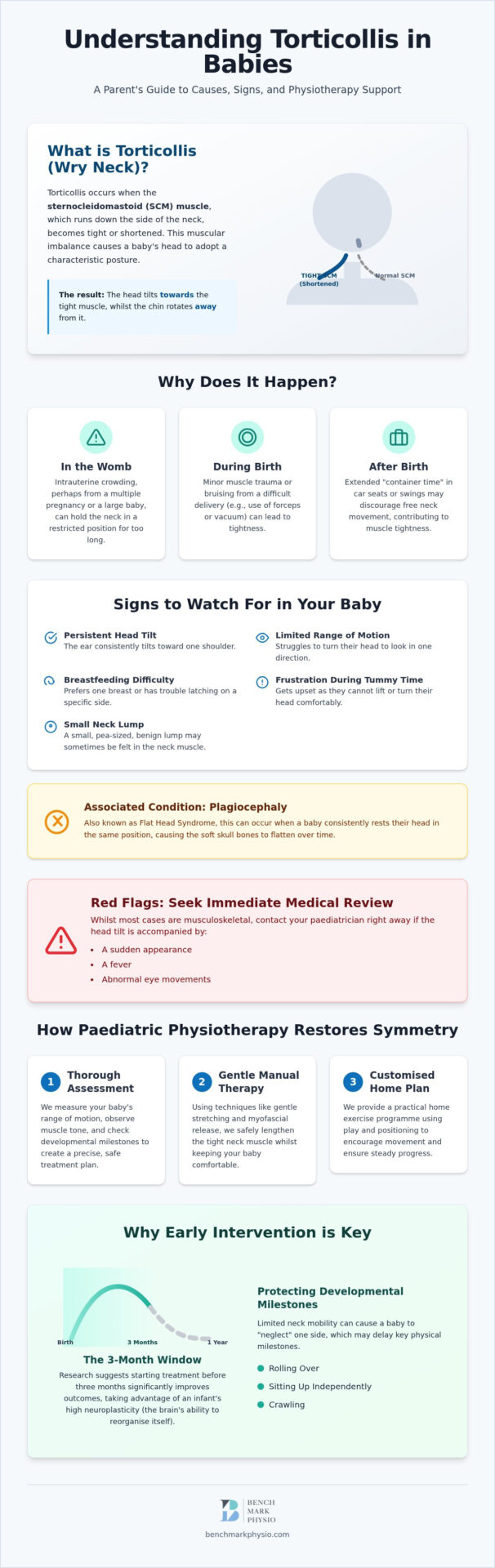
If your baby appears to have a "favourite" side, it’s often due to a condition called Torticollis, or wry neck. This occurs when the sternocleidomastoid (SCM) muscle, which runs along both sides of the neck from behind the ear to the collarbone, becomes tight or shortened. When one side is tighter than the other, it creates a characteristic posture: the head tilts toward the tight muscle whilst the chin rotates away from it. Understanding Torticollis in Babies: Causes Signs and How Physiotherapy Can Help begins with identifying whether the condition is congenital, meaning present at birth, or acquired later during infancy.
Common Causes: From Womb Positioning to Delivery
Congenital Muscular Torticollis (CMT) is frequently linked to intrauterine crowding. If space was limited in the womb, perhaps due to a large baby or a multiple pregnancy, the neck may have been held in a restricted position for too long. Similarly, birth trauma involving vacuum extraction or forceps can cause minor muscle trauma or bruising, leading to scar tissue that restricts movement. For babies who develop tightness later, "container time" in car seats or swings may play a role if they aren’t encouraged to move their necks freely. This physical restriction doesn’t just affect sleep; it can make breastfeeding difficult on one side, as the baby may struggle to latch comfortably when their neck rotation is limited. Early assessment through paediatric physiotherapy can help identify these underlying triggers and restore natural symmetry.
Recognising the Signs and the Importance of Early Intervention
Identifying the signs of a muscular imbalance early allows for more effective management. The most distinct visual cue is a persistent head tilt, where the ear is pulled toward one shoulder. You may also notice your baby consistently looks in one direction or has a small, pea-sized lump in the neck muscle. These physical restrictions often manifest during daily routines. For instance, your baby might show frustration during tummy time or experience difficulty whilst breastfeeding on a specific side. Because they cannot rotate their neck comfortably, latching becomes a challenge, leading to irritability during feeds.
Whilst most cases are musculoskeletal, certain "red flags" necessitate an immediate medical review. If the head tilt appears suddenly, is accompanied by a fever, or if you notice abnormal eye movements, contact your paediatrician right away. Understanding torticollis in babies and how physiotherapy can help ensures you can distinguish between typical muscular tightness and conditions requiring urgent clinical care.
Associated Conditions: Plagiocephaly and Developmental Milestones
Torticollis is frequently associated with positional plagiocephaly, or flat head syndrome. When a baby constantly rests their head on the same spot, the soft skull bones may flatten over time. Beyond head shape, limited neck mobility can cause a baby to "neglect" one side of their environment, which may delay milestones such as rolling, sitting, or crawling. Early intervention is vital. Research suggests that starting treatment before three months significantly improves outcomes because of an infant’s high level of neuroplasticity. If you have concerns about your child’s movement, booking a clinical assessment with a specialist can help ensure their development remains on track. As noted by Nemours KidsHealth on torticollis, consistent positioning and gentle stretching are key to restoring balance.
How Paediatric Physiotherapy Restores Movement and Symmetry
A paediatric physiotherapy session starts with a thorough clinical assessment. We measure your baby’s passive and active range of motion, observe their muscle tone, and check their developmental milestones to ensure treatment is safe and precise. Manual therapy often involves gentle stretching and myofascial release. These techniques help lengthen the tight neck muscle safely whilst ensuring your baby remains comfortable. This expert-led approach is central to understanding torticollis in babies, as it moves beyond generic advice to provide a targeted clinical solution.
We don’t just treat your baby in the clinic; we work as a supportive partner for your family. A tailored paediatric physiotherapy programme includes a customised home exercise plan. These movements are designed to be practical, fitting naturally into your baby’s existing routine to ensure steady, long-term progress.
Practical Strategies for Parents: Tummy Time and Positioning
Focus on "active stretching" through play by using bright toys or your voice to encourage your baby to rotate their head toward their non-favoured side. Supervised tummy time is equally vital for strengthening the neck and shoulder girdle. To support this, conduct a home environment audit to encourage movement in daily life:
- Alternate your baby’s head position in the cot each night to prevent them from always looking at the same wall or doorway.
- Position the changing mat so they must turn toward the "difficult" side to see your face.
- Minimise time in restrictive car seats or swings whilst your baby is awake.
Consistency leads to results. As noted by Nemours KidsHealth on Torticollis, early positioning changes and regular movement are the most effective ways to restore symmetry.
Supporting Your Baby’s Symmetrical Growth
book a paediatric assessment with Benchmark Physio today
With professional guidance and a consistent, gentle approach, your little one can gain the strength and flexibility needed to explore their world with confidence.
Frequently Asked Questions
Is infant torticollis painful for my baby?
Generally, torticollis doesn’t cause pain whilst your baby is at rest. However, they may become irritable or frustrated when they’re encouraged to turn their head toward the restricted side. This discomfort is typically due to the muscle’s tightness rather than an acute injury. If your baby experiences sudden, intense pain or cries excessively during gentle movement, seek a clinical review immediately to rule out other issues.
How long does it take for physiotherapy to fix torticollis?
Recovery times vary depending on the severity of the muscle tightness and how early treatment begins. When intervention starts before six months of age, many infants show significant improvement within several months of consistent care. Physiotherapy can help by providing a structured programme, but the duration of therapy depends on the child’s response and adherence to home exercises.
Can my baby grow out of torticollis without treatment?
It’s unlikely that a baby will simply grow out of this condition without active intervention. Whilst some mild cases may seem to improve as a baby gains neck strength, the underlying muscle shortening often remains. Without targeted stretching and positioning, the restriction can lead to secondary issues such as a flattened head shape or persistent postural habits that become harder to correct as the child grows.
What is the difference between torticollis and a "favoured side"?
A "favoured side" is often a habit or a mild preference, whereas torticollis is a physical restriction of the sternocleidomastoid muscle. If your baby has a preference, they can still look the other way when prompted. In cases of torticollis, the baby physically cannot achieve a full range of motion. A paediatric physiotherapist can perform a clinical assessment to determine if the issue is postural or structural.
Are there any long-term effects if torticollis is left untreated?
If left untreated, the persistent head tilt can lead to long-term facial and skull asymmetry, known as plagiocephaly. It may also impact how a baby reaches developmental milestones. Because the child may "neglect" one side of their body, they might struggle with symmetrical rolling, crawling, or sitting. Addressing torticollis in babies ensures these developmental paths remain clear and balanced.

Article by
Ng Hong Kai
Hong Kai has been practising musculoskeletal physiotherapy for more than a decade. He is the first Singaporean to achieve dual credentials as both an APA Titled Musculoskeletal Physiotherapist and a tertiary trained Exercise Scientist.
Hong Kai's broad and extensive skillset allows him to create solutions that are simple, effective and tailored to a client’s musculoskeletal needs. His beliefs in continuing education and self improvement led him to complete his Masters in Clinical Physiotherapy (Musculoskeletal), where he had a chance to participate in formal research into knee osteoarthritis under the supervision of world renowned researcher and physiotherapist Prof Peter 0′ Sullivan. Hong Kai has experience treating a variety of musculoskeletal conditions, with a specific focus on addressing lower back, neck, shoulder and knee pain.
Medical Disclaimer
Our articles are written to help readers better understand musculoskeletal health, injury prevention and physiotherapy. Content is researched using current clinical guidelines and peer-reviewed evidence where appropriate, and is reviewed for accuracy before publication. However, the information is intended for educational purposes only and should not be considered medical advice, diagnosis, or treatment, and should not replace an assessment by a qualified healthcare professional.
Every individual is different, and the causes and appropriate management of pain or injury can vary significantly. If you are experiencing persistent pain, worsening symptoms, significant weakness, numbness, loss of bladder or bowel control, or have sustained a serious injury, seek prompt medical attention.
Reading this article does not establish a physiotherapist-patient relationship with Benchmark Physio or its clinicians. If you require personalised advice, assessment or treatment, please consult a qualified physiotherapist or your healthcare provider.