
Home » Youth Sports Injuries
Paediatric Physiotherapy
Youth Sports Injuries Physiotherapy in Singapore
From growing pains that won't settle to a twisted ankle on the court, physiotherapy helps get young athletes assessed properly and back to sport with confidence — with an honest read on what's actually going on, and a plan to match.
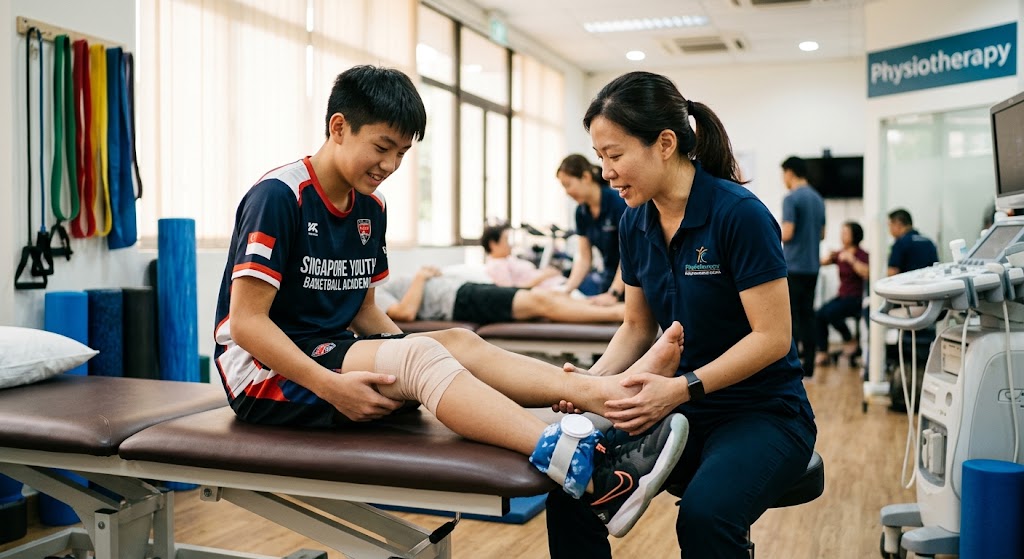
Why It Matters
Young athletes aren't just small adults — injuries need a growth-aware approach
A growing skeleton responds differently to load and impact than an adult one, so what looks like a straightforward sprain or "growing pain" isn't always managed the same way. Proper assessment gets young athletes back to training and competition safely, without rushing a return that sets them up for the same injury again.
What We're Assessing
The injury itself, alongside training load, growth stage, technique and any other factors that may have contributed — not just the painful area in isolation.
Why Early Review Helps
Playing through pain or returning too soon is one of the most common reasons a minor injury becomes a recurring one — early assessment usually means a shorter time out of sport.
Growth Plates Matter
Open growth plates are more vulnerable to certain injuries than adult bone and tendon, which is why some youth sports complaints need a different management approach entirely.
Coordinated Care
We liaise with coaches, school PE staff and your paediatrician or sports doctor where useful, so return-to-play decisions are consistent across the board.
What We Look At
Acute injuries and overuse injuries, explained simply
Youth sports injuries generally fall into one of these two categories, and the two need quite different first steps.
A single, identifiable incident — a rolled ankle, a fall, a collision — with pain, swelling or loss of movement starting straight away or within a day.
Common examples include ankle sprains, wrist fractures, hamstring strains and knee ligament injuries from sport such as football, netball or gymnastics.
Pain that builds gradually over weeks, usually linked to repetitive load — often around a growth plate — rather than one single moment of injury.
Common examples include Osgood-Schlatter (knee), Sever's disease (heel), and shoulder or elbow pain in young swimmers, throwers and racquet sport players.
A Useful Starting Point
Manage at home vs. patterns we'd like to review
This isn't a diagnosis tool — it's a guide for whether booking an assessment sooner is a good idea. When in doubt, an initial review costs you little and rules a lot out.
- Mild soreness after a new activity or increase in training, easing within a couple of days
- Discomfort that settles well with rest and doesn't affect how your child walks or moves
- Full, pain-free range of movement in the joint, with no swelling or bruising
- Your child is happy to keep light activity going and isn't guarding the area
- Noticeable swelling, bruising, or a visible change in shape after an injury
- Won't put weight through the limb, or is limping more than a day or two after the event
- Pain during or after sport that keeps returning over several weeks, or is gradually worsening
- Pain that wakes your child at night, or is out of proportion to what happened
These are general guides, not fixed cut-offs. An assessment will always consider your child's full history, including how the injury happened and how it's behaved since.
What Contributes
Common contributing factors
Youth sports injuries are usually multifactorial — assessment looks at the fuller picture rather than just the site of pain.
01
Rapid Growth Spurts
Bones can lengthen faster than the surrounding muscles and tendons can adapt, temporarily reducing flexibility and increasing strain around certain joints.
02
Training Load & Recovery
A sudden jump in training volume, playing one sport year-round, or limited rest days between sessions all raise the risk of overuse injury.
03
Technique & Biomechanics
Movement patterns picked up early — how a child lands, throws or changes direction — can place uneven load through developing joints and soft tissue.
04
Early Specialisation
Concentrating on a single sport from a young age, with the same movements repeated often, can increase the chance of a specific overuse pattern developing.
What To Expect
Our approach to assessing and treating your child
Every plan starts with a proper look at how the injury happened and how your child moves before we recommend anything — no generic rest-and-see advice handed out on a first visit.
01
Assessment & History
We talk through how the injury happened, your child's sporting and training background, then assess movement, strength and the affected area to build a full picture.
02
Tailored Treatment Plan
Findings are explained in plain terms, with a treatment and load-management plan built around your child's injury, sport, age and season timeline.
03
Guided Return to Sport
A staged return-to-play programme with clear milestones, so your child goes back to training and competition when they're genuinely ready — not just pain-free at rest.
Care Across Every Stage
Why timing matters at each age
What we look for — and how we treat it — shifts as your child grows and their sporting demands change, so a plan built for their current stage is more effective.
6–9 years
Foundational Movement
Injuries here are usually from falls or play rather than structured training — assessment focuses on ruling out anything growth-plate related and supporting a confident return to activity.
10–13 years
Growth Spurt Window
This is the peak window for overuse conditions like Osgood-Schlatter and Sever's disease, as training intensity often increases alongside rapid growth.
14 years+
Competitive Load
Training volumes and injury patterns start to resemble adult sport more closely, though growth-related sensitivity can still play a role and is factored into the plan.
Who's Looking After Your Child
Led by a Paediatric Physiotherapist with Advanced Specialist Training
Every plan is guided by clinical standards adapted thoughtfully for young athletes, and backed by ongoing professional development.
Session Fees
Straightforward pricing
Speak with us about insurance direct billing eligibility.
$260 / 45 mins
Assessment, treatment and home programme guidance at our Bukit Timah clinic.
$350 / 45 mins
Singapore-wide, for children more settled in a familiar environment.
Direct billing available with select insurance providers — see our full fees page for all services.
Common Questions
Frequently asked questions
At what age can my child be seen?
We see young athletes from around 6 years old through to the teenage years, across most school and club sports. Earlier assessment generally means a faster, safer return to training.
Do I need a doctor's referral first?
No referral is required to book an initial assessment. If a fracture or more serious injury is suspected, we'll advise on imaging or a medical review, and we're glad to coordinate directly with your paediatrician or sports doctor where one is already involved.
Should my child stop playing sport completely?
Not always — it depends on the injury. Some conditions allow modified training to continue alongside treatment, while others need a period of rest from the aggravating activity. We'll give clear, specific guidance rather than a blanket "stop everything" answer.
Is this the same as Osgood-Schlatter or Sever's disease?
These are two of the more common overuse conditions we see in growing athletes, alongside many others. We'll confirm what's actually going on at assessment rather than assuming, since management differs depending on the specific diagnosis.
How many sessions will my child typically need?
This depends on the injury and how early treatment starts — a straightforward sprain may need only a short course of visits, while overuse conditions linked to growth are often reviewed over a longer period alongside training adjustments. We'll give you a clear expected timeline after the initial assessment.
Is this covered by insurance?
Coverage depends on your specific policy. We offer direct billing with select insurance providers — reach out and we'll help confirm your child's eligibility.
Ready to get a clear picture?
Book an initial assessment and we'll give you an honest read on the injury — and a plan to get your child back to sport safely.
📍 557 Bukit Timah Road, #02-03, Crown Centre, Singapore 269694 · 📞 +65 8836 8526

Meet Our Paediatric Physiotherapist
Ahmad Iqbal Bin Kamari, a paediatric physiotherapy specialist, has carefully reviewed the information on this page.

Principal Paediatric Physiotherapist
- Master of Advanced Paediatric Physiotherapy Practice (Monash University, Australia)
- BSc (Hons) in Physiotherapy (SIT-TCD))
- FIFA Diploma in Football Medicine
- Full registration with Allied Health Professions Council, Singapore, and Health and Care Professions Council, UK
Ahmad Iqbal Bin Kamari blends high-level clinical precision with an energetic, child-centered approach to paediatric physiotherapy. Holding a Master of Advanced Paediatric Physiotherapy Practice from Monash University, a BSc (Hons) from SIT-TCD, and a FIFA Diploma in Football Medicine, he brings specialist clinical training from KK Women’s and Children’s Hospital (KKH) and Evelina London Children’s Hospital. His rich expertise spans Early Intervention, Special Education (SPED), youth sports care, and his leadership as a Special Olympics Clinical Director.
At the heart of his practice—and his teaching as an SIT faculty member—is the belief that real movement progress starts with trust. Ahmad designs every session to be a safe, warmly tailored environment where children and youth feel completely comfortable to explore, play, and challenge themselves. By meeting each young person at their level, he turns therapy into an engaging experience that builds both physical strength and lasting confidence under his care.
- Early Intervention
- Special Education (SPED)
- Youth Sports & Adapted Athletic Care